As some of you may already know, the European region is going to put new validation criteria into effect in September 2011.
The new criteria can be found on the eSubmission web site at the following link: http://esubmission.emea.europa.eu/
What is this going to mean for validation tools and eCTD validation for the European region?
For one, the previous priority levels of A, B, and C have been removed, and have been replaced by Pass, Fail, and Best Practice.
For the Pass/Fail checks, any eCTD that fails to pass all checks will be returned to the applicant for fixing and resubmission. Additionally, according to the new criteria, the Best Practice checks are now strongly recommended.
From the Best Practice description found in the Validate Criteria 3.0 document:
“The applicant should make every effort to address these areas before the eCTD is submitted to the agency. The applicant should be prepared to include justification for any Best Practice criteria not met in the submission cover letter/reviewer’s guide.”
The most critical point to take away from this change to the priority levels is that now all tests must pass. Yes, eCTDs that fail to pass Best Practice checks will be accepted during technical validation, and may not even be checked, but based on the previous statement, it is clear that the European authorities are really pushing for clean eCTD submissions.
Another item new to the criteria is an indication that a validate check can only be performed in the context of other eCTDs in the lifecycle. This indication has been set on checks which relate to operations and submissions in other sequences. For example, “11.9: The leaf referenced by the modified file must exist in a previously submitted sequence within the same eCTD application”. If you were only validating one sequence that has a leaf modifying a leaf in a different sequence, then this check could not be fully completed unless the other sequence was present during the validation. In this case, validation tools should indicate if the other sequence was present or not when the checks were done.
For more information please click here: THE eCTD SUMMIT: EU: eCTD Validation Criteria 3.0
18 July 2011


DIA:12th Conference on European Electronic Document Management/ EDM - Zurich, Switzerland.
DIA:12th Conference on European Electronic Document Management/ EDM - Zurich, Switzerland.
Location:
Swissôtel Zurich
Am Marktplatz Oerlikon
8050 Zurich
Switzerland
Interest Area(s):
Clinical Data Management/ eClinical,CMC,Clinical Research,Document Management/ eSubmissions,IT/Validation,Medical Writing,Strategic Planning,Quality Assurance/Quality Control,Regulatory Affairs
Overview:
For the past few decades, as we moved from paper-based content to electronic files, we have kept a clear distinction between documents and data, and the context in which this content was used. Data was managed in structured databases, analysed, then transferred manually, and documents were recreated over and over again and stored in eDM systems.
Today this separation is slowly disappearing as new technologies, such as XML, bring documents, data and other forms of information together in one melting point. This evolution is welcome and opens new perspectives in areas such as collaboration, reuse, review, analysis and records management. It also creates new challenges and pharmaceutical professionals will need to revise their view and practices and gradually move from traditional data and document management to information and content management.
DIA has always been in the forefront of new ideas and technologies and will once more offer a privileged forum for discussing, understanding and addressing the new challenges of information management.
For more information click here: DIA:12th Conference on European Electronic Document Management/ EDM - Zurich, Switzerland
Regulatory Document Management with Microsoft SharePoint 2010 and NextDocs
The full set of documents that ultimately comprise an eCTD submission need to be managed through a complete lifecycle, from creation through submission. In addition to ensuring compliance with 21 CFR Part 11, a broad set of users need to have access to create, review, approve and update each document. During this session you will see how SharePoint 2010 can be used to address the complete set of requirements for managing regulatory documents in a life sciences environment.
This on-line session will include a complete demonstration of a system built on SharePoint 2010 and using the DIA Reference Model for managing regulatory documents and the associated metadata. Key topics that will be addressed: – How SharePoint 2010 can address the complete set of 21 CFR Part 11 requirements including digital signatures, extended audit trails, and version control – The role of the DIA Reference Model in simplifying and standardizing the organization of regulatory documents – How SharePoint can act as a unified repository for managing all regulatory documents through their entire life cycle from creation through submission – Integrating SharePoint 2010 with eCTD assembly and publishing solution
For more information and free video click here: Regulatory Document Management with Microsoft SharePoint 2010 and NextDocs
It’ll be an XML world
Steve Ballmer, the CEO of Microsoft, proclaimed back in March of 2001. Eight years later, we're still waiting.
Sure, XML has made some inroads. For instance, as of late 2005, FDA requires that all US-marketed package inserts be submitted in XML format. So far, the goal for most organizations was solely to implement systems and/or processes to achieve compliance with Structured Product Labeling. By and large, though, drug and device companies are still publishing (and thus translating) content in unstructured formats.
This is a shame, for both manufacturers and translation companies. Use of XML would offer the opportunity to reduce turnaround times through reduced analysis time and a generally simpler process flow (fewer steps, fewer technical issues). It would allow translators to focus on linguistic work without the distraction of desktop publishing tasks (focus on core competency).
For More information Please click here: It’ll be an XML world
DIA Europe: Training Course for eCTD - Submissions in Switzerland
Since January 2010, Swissmedic accepts electronic-only submissions in eCTD-format. This course will offer insight into the compilation of the eCTD, share experience and best practice gained during eCTD submissions in Switzerland, and the eCTD review process. The focus will be on practical experience gained in preparing and submitting eCTDs to Swissmedic.
Hotel Courtyard Marriott Zurich, Zurich, Switzerland
Dec 8 2011 9:00AM - 5:00PM
Registration:
DIA EUROPE
ELISABETHENANLAGE 25, POSTFACH
4002 BASEL, SWITZERLAND
PHONE: +41 61 225 51 51
FAX: +41 61 225 51 52
E-mail:diaeurope@diahome.org
For More information please click here: DIA Europe: Training Course for eCTD - Submissions in Switzerland
CUSTOpharm: New eCTD Software Looking for Beta Testers
A new easy to use eCTD software is entering the final phases of beta testing and we are looking for volunteers to evaluate and provide input crucial to the finalization and completion of the software.
This software is based on the principles that software should be easy to pick up and use and therefore does not require extensive training and is designed to be "Mac" like in its ease of use. However, if anybody needs instructions we are more than happy to help.
Currently, we are looking for volunteers to evaluate the capabilities of the software and make recommendations as to how to improve it. Ideal beta testers would be regulatory consultants working on a variety of submissions types for the US market; however direct pharmaceutical employees are requested to register as well. This is a rare opportunity to use an eCTD software package at no cost.
For More Information please click here: CUSTOpharm: New eCTD Software Looking for Beta Testers
A Case Study for a Global Submission eArchiving System - By Mauricha F. Marcussen
A Case Study for a Global Submission eArchiving System - By Mauricha F. Marcussen, Senior Consultant, Edward S. Tripp and Associates, Inc.
Please click here to find the presentation: A Case Study for a Global Submission eArchiving System - By Mauricha F. Marcussen
Please click here to find the presentation: A Case Study for a Global Submission eArchiving System - By Mauricha F. Marcussen
15 July 2011
CSC : CDISC Data Standards and Your Regulatory Submission: It's Time to Implement - Complementary Webinar
CDISC Data Standards and Your Regulatory Submission: It's Time to Implement
Thursday, July 28, 2011, 8:00 am pacific time / 11:00 am eastern time / 13.00 BST
Interchange Standards Consortium (CDISC) data standards for all regulatory applications delivered to the agency. In fact, on July 21, 2004, the FDA issued a press release announcing that the CDISC Study Data Tabulation Model (SDTM) was the preferred method for submission of source data to the Center for Drug Evaluation and Research (CDER).1 Analysis data used in the clinical statistical review also is being standardized, and CDISC released the Analysis Data Model (ADaM) implementation guide V1.0 in late 2009. The ramifications of these data standards are far-reaching for sponsors. The FDA is now considering a rule change that would mandate the submission of data in these standard formats for all new marketing applications. In addition to the FDA, other government organizations such as the National Cancer Institute and the National Institutes of Health actively incorporating these standards. Unfortunately, even in 2011, only a very small percentage of sponsors are developing and submitting the SDTM and ADaM.
Trend and Opportunities
In this informative and complimentary Webinar, CSC subject-matter expert Gregory Ridge will discuss CDISC's history, the FDA's usage of data standards and sponsor implementation strategies across both the SDTM and ADaM. The conversion of legacy source data to CDISC data standards is a costly proposition in terms of time and resources. Topics included will be the development of a submission data plan and gaining an understanding of the source-to-CDISC conversion process. The discussion will also focus on development of the supportive metadata required in a CDISC submission, commonly called the define.xml.
Key Learnings
Industry Trends: Learn about the history of CDISC and how its standards are utilized at the FDA. Examine the most current metrics on how sponsors are dealing with migration to CDISC and how partner organizations can assist in the development and validation of a company's submission package.
Success Factors: Understand the process of conversion of legacy source data to CDISC models. Discover what's required to migrate a company's submission data package from legacy to state of the art.
Risk and Reward: Determine the strategy that best suits a company's data submission needs. Recognize the current regulatory landscape, and develop a submission plan that best mitigates the company's risks.
A Complete Solution: Learn about all of the components of an electronic submission and how they integrate with a company's dossier. Understand the challenges that must be met to develop a CDISC data package, and learn the costs - in terms of both financing and resources - associated with it.
About the Presenter
Gregory Ridge is group leader of the Regulatory Data Standards and Integration organization at CSC. He has 20 years of pharmaceutical programming experience. His CSC team has developed multiple successful CDISC data packages for clients in a variety of therapeutic areas. Prior to joining CSC, Greg was associate director of clinical programming at sanofi-aventis for 14 years, leading the oncology and cardiovascular therapeutic areas. His teams successfully submitted nine CDISC-compliant submissions to the FDA by utilizing multiple release versions of the SDTM and ADaM.
Please click here to Register this webinar: CSC : CDISC Data Standards and Your Regulatory Submission: It's Time to Implement - Complementary Webinar
AAMI News: E-Submissions Coming for Manufacturers
Hospitals aren’t the only ones that are moving to electronic records. Manufacturers face that change, too, and they need to prepare to submit their medical device applications to regulators electronically, standards experts say.
“The message here is that e-submissions are coming,” said Bernie Liebler, director of technology and regulatory affairs for Advanced Medical Technology Association (AdvaMed), a Washington, DC-based trade group representing device manufacturers. “The pharmaceutical industry is pushing for e-submission standards that can also be used for devices.”
The healthcare informatics standards organization Health Level Seven International (HL7) is creating such a standard, one that will include guidelines on how to submit applications electronically for regulated drugs and medical devices to authorities around the world.
Liebler, who spoke during a May 23 webinar sponsored by AdvaMed on e-submissions, called for the formation of an international working group of device manufacturers to help develop the standard.
For more information please click here: AAMI News: E-Submissions Coming for Manufacturers
14 July 2011
e-submissions look scary?
Electronic records are everywhere these days - healthcare providers, patients, and now event manufacturers face that change. More and more pharmaceutical and medical device companies are preparing to submit applications to regulators electronically.
The healthcare IT standards organization Health Level Seven International (HL7) is creating a standard that will include guidelines on how to submit applications electronically for regulated drugs and medical devices to authorities around the world.
The most recent issue of AAMI News reports that HL7 plans to test the regulated product submission (RPS) in the fall of 2011, and the International Organization of Standardization plans to adopt the standard as early as 2013.
For More Information please click here: e-submissions look scary?
EXTEDO Webinar - The New EU Validation Criteria and EURSvalidator 2.0
EXTEDO is Hosting a Complimentary Webinar!
The New EU Validation Criteria and EURSvalidator 2.0
During this webinar Dr. Gerhard Neurauter (Director Regulatory Competence Center at EXTEDO) will provide an overview of the changes in the EU validation criteria and will show you how to validate your submission according to the new rules with EXTEDO's EURSvalidator 2.0. The following topics will be covered during the webinar:
•History and roadmap of EURSvalidator
•EURSvalidator 2.0 - What's new
•Reports and documentation
•The new validation criteria for eCTD and NEES
•Implementation of the new validation criteria in EURSvalidator
•Best practice: Switching from eCTD validation criteria 2.1 to 3.1
•Live demo of EURSvalidator 2.0
•Update of the validation library of eCTDmanager / EURS is Yours with EURSvalidator
To Register the Webinar Please Click here: EXTEDO Webinar - The New EU Validation Criteria and EURSvalidator 2.0
Exalon: TIGes updates clarification on the new EU eCTD validation criteria
The Telematic Implementation Group for electronic submission and ICH Implementation (TIGes) has updated the clarification document on the draft eCTD validation criteria 3.1 that will come into force in September this year. The initial version of the clarification document was published in June (see our related News article)
In the updated version, additional clarification concerning the usage of eCTD style sheets is provided. As reported by TIGes, "several agencies noticed that for some eCTD submissions the style sheets provided by the eCTD building tools do not produce the correct MD5 checksum".
The TIGes confirms now that only the official style sheets are allowed in the eCTD as validated by correct MD5 checksums. (Note: Official style sheets for Module 2 - Module 5 are released by ICH; the regional EU Module 1 style sheet is part of the regional EU Module 1 package as released by TIGes - original MD5 checksums are provided on the download pages).
For More Information Click here: Exalon: TIGes updates clarification on the new EU eCTD validation criteria
NextDocs: Using SharePoint 2010 with NextDocs as a Complete Quality Management System - Webinar Slides
NextDocs: Using SharePoint 2010 with NextDocs as a Complete Quality Management System - Webinar Slides
Webinar Slides Can view by clicking the below weblink: NextDocs QMS Webinar Slides
Recorder Webinar Can hear by clicking the below weblink: NextDocs QMS Webinar Record
Webinar Slides Can view by clicking the below weblink: NextDocs QMS Webinar Slides
Recorder Webinar Can hear by clicking the below weblink: NextDocs QMS Webinar Record
eCTD Publishing Specialist (Contract/Freelance) - Regulatory Affairs - UK South/South East - Negotiable daily rate.
One of the client is looking for a talented individual to join their exisitng successful team on a contract/freelance agreement. The role is a pivitol part of the team. Please see an outline of the role below or look at our website - www.morganprestwich.com
Person Spec:
•Experience with NEES, eCTD and Paper Submissions
•Knowledge of European procedures (Centralised, Decentralised and Mutual Recognition)
•Good written and communication skills
•Use of docuBridge or similar publishing tool
•A confident user of MS Office, Adobe Acrobat and ISI Toolbox (Preferable)
•General understanding of regulatory affairs
RESPONSIBILITIES
•Maintain well established infrastructure for electronic submissions and eCTD.
•Make sure that the published regulatory submission is in accordance with the relevant guidelines ICH M2 (eCTD Specification), ICH M4 (Q, E, S, Organisation CTD), EU Module 1 Specification etc.) and contains all necessary navigation tools like bookmarks and hyperlinks which provide essential navigational aids for the reviewer.
•Communicate with regulatory agencies (EMA, local competent authorities) with respect to electronic regulatory submissions, answer technical queries, resolve technical issues (with relevant IT support).
•Responsible for the preparation of the same eCTD submissions for planned MAAs (e.g. Computer Validation testing by EMA).
To apply
Please send your CV to Greg Bell - greg.bell@morganprestwich.com or call me on 01737 22 66 44 to discuss this and othe positions further.
Regulatory Affairs eCTD Publishing Specialist ~ 10 -12 Month Contract ~ Surrey ~ July Start !!
Independent consultancy with office throughout Europe who deliver a highly professional service to the Pharmaceutical industry encompassing Regulatory Affairs, PVG, Health Economic Evaluation and QA.
They have a requirement for a Regulatory Affairs eCTD publishing specialist, the position can accommodate some home working but will be mainly office based at my clients offices in Surrey therefore I cannot accept applications from candidates who cannot commute to Surrey.
Suitable Candidates will have experience in the following,
-Experience with NEES, eCTD and Paper Submissions
-Knowledge of European procedures (Centralised, Decentralised and Mutual Recognition)
-Good written and communication skills
-Use of docuBridge or similar publishing tool
-A confident user of MS Office, Adobe Acrobat and ISI Toolbox (Preferable)
-General understanding of regulatory affairs
RESPONSIBILITIES
-Maintain well established infrastructure for electronic submissions and eCTD.
-Make sure that the published regulatory submission is in accordance with the relevant guidelines ICH M2 (eCTD Specification), ICH M4 (Q, E, S, Organisation CTD), EU Module 1 Specification etc.) and contains all necessary navigation tools like bookmarks and hyperlinks which provide essential navigational aids for the reviewer.
-Communicate with regulatory agencies (EMA, local competent authorities) with respect to electronic regulatory submissions, answer technical queries, resolve technical issues (with relevant IT support).
A full job description is available on application.
Kind regards
Paul Duffy
Manager ~ Contracts Division
Specialist Contract Pharmaceutical Recruitment
+44 (0) 1293 77 66 44
paul@barringtonjames.com
Click Here for www.barringtonjames.com
IF YOU ARE CURRENTLY CONTRACTING OR INTERESTED IN CONTRACT OPPORTUNITIES THEN PLEASE VISIT OUR LINKEDIN GROUP
“THE PHARMACEUTICAL CONTRACTOR AND FREELANCE NETWORK”
Danish Medicines Agency: Electronic clinical trial Applications (e-CTA) Do not meet Format Requirements
Electronic clinical trial applications do not meet format requirements
A month ago, the Danish Medicines Agency announced that it is possible to submit clinical trial applications electronically, and we are happy to see that many have taken advantage of this possibility.
Unfortunately, we receive quite many applications that do not comply with the requested format. The most common error that we see is that several files are submitted in various formats (PDF, Word and emails).
This delays the start-up phase of our review, and we therefore call attention to the description of the requested format.
In the event that it is not possible to submit one PDF file with bookmarks, we accept the submission of separate PDF files for each of the submitted documents with unambiguous file names (e.g. "Cover letter", "Protocol", "EudraCT application form", etc.).
If you use Eudralink to submit several files, please send them in one ZIP file.
For More Information Please click here: Danish Medicines Agency e-CTA
13 July 2011
Cato Research & GlobalSubmit: Reasons to Switch to eCTD By Evan M. Richardson - Webinar Slides
Reasons to Switch to eCTD
13 July 2011
Evan M. Richardson, B.S., R.A.C.
Associate Director, Regulatory Operations
Cato Research Ltd.
Please click here to view or download the slides: Webinar Slides
13 July 2011
Evan M. Richardson, B.S., R.A.C.
Associate Director, Regulatory Operations
Cato Research Ltd.
Please click here to view or download the slides: Webinar Slides
11 July 2011
FDA's Drug-Approval Rate for 2011 on Pace to Exceed 2010
WASHINGTON—The Food and Drug Administration has approved 20 new drugs so far this year, just one short of the total for all of 2010, according to a top agency official.
The pace likely puts the FDA on track to approve more new types of drugs in 2011 than the previous few years.
In testimony before the House Energy and Commerce's health subcommittee, Janet Woodcock, the head of the FDA's drug division, responded to some lawmakers concerns that a tougher safety stance taken by the agency was slowing down the pace of drug approvals and hurting the pharmaceutical and biotech industry.
FDA's drug approval figures involve drugs or biologics—which are made from living cells—that are considered new types of products. They don't include approvals granted for new formulations or new uses of existing drugs as well as vaccines.
Ms. Woodcock explained the agency meets more than 90% of deadlines that are part of the drug-review process. She also said so-called first cycle approvals are at a 20-year high with and said more than two-thirds of new drugs being approved within the six-to-10-month time frames given to new drug applications. In other cases companies are asked to submit more information, which prompts additional reviews, or drugs are rejected.
For More Information please use the below weblink: The Wall Street Journal - FDA's Drug-Approval Rate for 2011 on Pace to Exceed 2010
NextDocs:Using SharePoint 2010 with NextDocs as a Complete Quality Management System (QMS) - COMPLIMENTARY WEBINAR On July 12, 2011
A complete quality management system (QMS) includes solutions for CAPA, Deviations, Complaint Management and more, all operating as components of an integrated, closed-loop system. This is exactly what you will see during this one-hour online session.
Managing quality processes in accordance with 21 CFR Part 11 and related regulatory requirements involve collecting and documenting critical activities and incidents, and ensuring that appropriate notifications and actions follow.
During this session you will see a solution based on SharePoint 2010 including the ability to collect the required documentation, manage it in a compliant manner, notify the correct individuals and launch the required corrective or preventative processes. The result is an integrated, closed loop quality management system.
This one-hour session will cover:
An overview of SharePoint 2010 in the context of managing quality processes in a life sciences environment
A demonstration of a complete Deviation >> CAPA cycle, including initial documentation, notifications to the correct parties and generation of a resulting corrective action.
A discussion of how SharePoint 2010 addresses regulatory requirements for managing quality processes
For More information and Register to the webinar please use the below mentioned weblink: NextDocs Quality Management System - COMPLIMENTARY WEBINAR
10 July 2011
NextDocs Corporation: NextDocs Compliance with Key European Regulations - By Kathie Clark, Director, Product Management
Unlike the U.S. Food and Drug Administration, European Health Authorities do not have a single document that defines the authorities‟ position on electronic records and electronic signatures. That is, there is no single document that is the equivalent of Code of Federal Regulations, Title 21 - Food and Drugs, Part 11 - Electronic Records; Electronic Signatures.
NextDocs has been asked to provide a response to specific regulations that cover aspects of electronic records and electronic signatures. This paper provides a response to the requirements of four specific regulations.
Please use the following web link to read or download the white Paper: NextDocs Corporation: NextDocs Compliance with Key European Regulations
06 July 2011
Regulatory Submission Publisher II - Job Opening in US
This position will be responsible for publishing electronic/paper regulatory submissions for US, European and rest of the world filings by working with Regulatory Affairs and project teams. If you possess 3 years of pharmaceutical/biotech industry experience with a minimum of 2 years of experience with publishing electronic/paper regulatory submissions.
Expert knowledge and experience with publishing eCTD submissions, and you're interested in working for an innovator in biotecnology, please contact me. Phone: +1 866-203-8227 x6606, or email:Sharon.Thornton@rightthinginc.com.
Expert knowledge and experience with publishing eCTD submissions, and you're interested in working for an innovator in biotecnology, please contact me. Phone: +1 866-203-8227 x6606, or email:Sharon.Thornton@rightthinginc.com.
DIA: Electronic Submissions 2011: 10th Anniversary Conference: Moving into the Next Generation of Electronic Submission Standards
Title:
Electronic Submissions 2011: 10th Anniversary Conference: Moving into the Next Generation of Electronic Submission Standards
Date(s) And Time(s):
Nov 16 2011 8:30AM - Nov 17 2011 5:00PM
Location:
The Westin San Diego Hotel
400 West Broadway
San Diego, CA 92101
Interest Area(s):
Regulatory Affairs,Document Management/ eSubmissions,IT/Validation,Medical Writing,Clinical Data Management/ eClinical,Project Management,Clinical Research
For more information about the conference please click here: DIA Electronic Submissions 2011: 10th Anniversary Conference
Andrew Marr assesses the impact of the EMA announcement on Medicinal Product Information
Andrew Marr assesses the impact of the of the EMA announcement of 1 July 2011 on the mandatory provision of medicinal product information (EVMPD) by 2 July 2012. This article originally appeared on www.regulatoryaffairspharma.com.
Please click here to find more information: Andrew Marr assesses the impact of the EMA announcement on Medicinal Product Information
Please click here to find more information: Andrew Marr assesses the impact of the EMA announcement on Medicinal Product Information
AEMPS: Spanish Medicines Agency Released Version 2.0 of the National eSubmission Guidance
AEMPS: Spanish Medicines Agency Released Version 2.0 of the National eSubmission Guidance.
For More information about the Guidance please click here: AEMPS eSubmission Guidance
For More information about the Guidance please click here: AEMPS eSubmission Guidance
FDA: Updated Study Data Specification Guidance (Version 1.6)
The U.S. Food and Drug Administration (FDA) has released an updated version 1.6 of the "Study Data Specifications" used for submitting animal and human study datasets in electronic format.
The new version 1.6, version date 2011-06-22, includes now specifications for general toxicology and carcinogenicity data tabulation datasets. The corresponding "Standard for Exchange of Nonclinical Data Implementation Guide: Nonclinical Studies" has just been released by CDISC as final version 3.0. (SEND IG 3.0). The SEND IG 3.0 is now referenced in the Study Data Specification 1.6 as Implementation Guide for which corresponding SDTM datasets are accepted by CDER starting with June 22, 2011.
For More Information Please click here: FDA: Updated Study Data Specification Guidance (Version 1.6)
05 July 2011
GlobalSubmit IT & IS Team Webinar :FDA views an electronic submission
upcoming web demonstration to discover the advantages of using GlobalSubmit 2010.
•See how the FDA views electronic submissions
•Build your application as the FDA sees it
•Cut days off the time it takes to quality check bookmarks and hyperlinks
•Improve your communications both internally and with the Agency
•Improve your team’s efficiency and meet important deadlines
•Reduce your risk of technical rejections
To Register the webinar click here: GlobalSubmit IT & IS Team Webinar :FDA views an electronic submission
Apex Regulatory Blogspot: How to file eCTD in MRP/DCP - One decision already made?
When filing a new eCTD using the Mutual Recognition or Decentralised Procedure, you need to be aware of the following question:
“When an application refers to multiple strengths or dosage forms, should I create one eCTD covering ALL strengths and dosage forms, or should I create one eCTD for EACH?”
This is no concern under the centralised procedure, where one eCTD will be submitted to cover all dosage forms and strengths: i.e. there’s no room for discretion.The advantages and disadvantages of both approaches are discussed in the TIGes guidance, but can be summarised as follows:
For More Information please click here:Apex Regulatory Blogspot: How to file eCTD in MRP/DCP - One decision already made?
02 July 2011
European Medicines Agency (EMA) publishes format for submission of information on medicines
Due to the new pharmacovigilance legislation implementation marketing authorisation holders (Pharmaceutical Companies) needs to submit electronic submission of information on medicinal products for human use to the European Medicines Agency.
The format shows the types of information that companies will need to submit to the Agency by the legal deadline of 2 July 2012.
For More Information please clikc here: EMA New format for submission of information on medicines
The format shows the types of information that companies will need to submit to the Agency by the legal deadline of 2 July 2012.
For More Information please clikc here: EMA New format for submission of information on medicines
30 June 2011
SIDC(Slovakian Agency) - Ongoing Issues for Processing Electronic Submissions (eCTD)
eCTD (Electronic Common Technical Document), is a standard format and interface for electronic delivery of documentation submitted to Medicines Agency for the purposes of registration of medicines or variations. eCTD structure is based on CTD format (Common Technical Document).
The intensive preparations are underway for the implementation of electronic filing and processing applications (eCTD) in practice. Launch of this process is by the end of 2011. For the success of the eCTD project is inavitable that applicants are familiar with the requirements to fill an application and its identification.
Up to 10th June 2011, 37 applications submitted to SIDC in eCTD format have been tested. Only 3 (~8%) applications fully meet the validation criteria of eCTD version 3.1.
For More Information Please click here: SIDC(Slovakian Agency) Ongoing eSubmissions Issues
Apex Regulatory Blog: Document Management
The importance of effective document management can’t be overstated in founding and maintaining an efficient, well ordered and audit ready Regulatory department. DMSs such as SCORE or Documentum’ FirstDoc are powerful tools which primarily act as a repository for your company’s documents. But they can do so much more than this. They are designed to: interact with publishing software, enable document workflows, archive documents, provide audit trails…there are too many features to list here!
So, what do I mean by ‘effective document management’? Well, from my experience working in a number of systems and seeing first hand the nightmares that substandard document management can cause.
For More Information Please click here: Apex Regulatory Blog: Document Management
So, what do I mean by ‘effective document management’? Well, from my experience working in a number of systems and seeing first hand the nightmares that substandard document management can cause.
For More Information Please click here: Apex Regulatory Blog: Document Management
JAZMP (Slovenian Agency): INSTRUCTIONS FOR THE SURRENDER OF APPLICATIONS AND VALIDATION CRITERIA IN ECTD and NeeS FORM
The purpose of this guide is to fully define the requirements of the Public Agency for Medicinal Products and medicinke devices (hereinafter JAZMP) technical validation for successful applications in the format e-CTD and NeeS.
Scope
Guidance should be used by applicants who apply on JAZMP role in electronic format or e-CTD NeeS.
E-CTD format or NeeS investors can apply for the following types of applications:
1st Authorisation Holder,
2nd Expansion of an existing permit holder,
3rd Renewal of Marketing Authorisation
4th Changes to the terms of marketing,
5th Periodic Safety Update Report (PSUR);
JAZMP accepts such types of applications for MRP, DCP, NP and CP procedures in human medicine for procedures for medicinal products for veterinary use and accept electronic applications in VNeeS format.
For More Information Please click here: JAZMP (Slovenian Agency) eCTD & Nee'S Updates
GlobalSubmit: Clinical Study Reports to STFs
What are STFs, how are STFs used, and why are STFs good?
Study Tagging Files, or STFs, organize study information into meaningful, standardized headings, not provided by the eCTD DTD, which allows reviewers to quickly understand what has been submitted and what has not. STFs provide consistency over the lifecycle of the regulatory application.
An STF should be provided with the submission of any file, or group of files belonging to a study in Modules 4 and 5. STFs are required by the United States, are not required in Europe and Canada, and are not allowed in Japan.
To understand STFs sufficiently you need to understand the index.xml.
For more information click here: GlobalSubmit STF
27 June 2011
Beyond eCTD: The Regulated Product Submissions Standard by Joel Finkle
Beyond eCTD: The Regulated Product Submissions Standard by Joel Finkle - Senior Strategist, Regulatory Informatics, CSC.
Please click here to find the Article: Beyond eCTD: The Regulated Product Submissions Standard by Joel Finkle
Please click here to find the Article: Beyond eCTD: The Regulated Product Submissions Standard by Joel Finkle
25 June 2011
Paperless Submission - Current Situation in the EU By Rob de Haan & Alaistair Nixon
Presentaion of Paperless Submission - Current Situation in the EU from Rob de Haan of MEB and Alaistair Nixon of GSK Regulatory Publishing. Including eCTD and NeeS Submissions.
Please click here to find the presentation: Paperless Submission - Current Situation in the EU
Please click here to find the presentation: Paperless Submission - Current Situation in the EU
Ask Cato:Is FDA Issuing More Refuse-to-File Letters?
The June 2011 issue of Nature Reviews: Drug Discovery (volume 10, page 403) includes an interesting news brief regarding the apparent increase in Refuse-to-File (RTF) letters being issued by FDA in recent years.
In a review of publicly available RTF letters, researchers at Leerink Swann found that 15 RTF letters were issued from 1998 to 2009 and that there have already been 13 issued since 2009. Among the reasons for given for several RTFs in the last two years.
For More Information Please Click Here: Ask Cato:Is FDA Issuing More Refuse-to-File Letters?
Webinar: How to Avoid the Dreaded Refuse-to-File, Plus 2012 eCTD Mandate from Congress - Sept. 6, 2011, 2-3 PM EDT - By Antoinette Azevedo
One of our most praised presentations, this Webinar by renowned eCTD expert Antoinette Azevedo will provide an overview of best practices to enable a sponsor to prepare a compliant eCTD for regulatory authority review. So you can avoid a costly Refuse-to-File (RTF) by FDA.
6 Things You will Learn:
Top issues regulatory authorities have with eCTD and how to avoid them.
Preparing submission-ready source documents and datasets for submission in eCTD.
Whether to purchase an eCTD publishing system or to outsource.
The role of an electronic document management system (EDMS) in an eCTD publishing solution?
How to prepare for the technical challenges of eCTD.
How to interact with regulatory authorities to assure your eCTD submission is accepted for review.
For More Information Please Click Here How to Avoid the Dreaded Refuse-to-File, Plus 2012 eCTD Mandate from Congress
22 June 2011
CDISC Releases Final v3.0 Standard for Exchange of Nonclinical Data (SEND) Implementation Guide
The CDISC SEND Team is pleased to announce the release of the SEND Implementation Guide (IG) Version 3.0.
The SENDIG is intended to guide the organization, structure, and format of standard nonclinical tabulation datasets for interchange between organizations such as sponsors and CROs and for submission to the US Food and Drug Administration (FDA).
Version 3.0 of the SENDIG in now the production version and is designed to support single-dose general toxicology, repeat-dose general toxicology, and carcinogenicity studies. The SENDIG is based upon and should be used in close concert with Version 1.2 of the CDISC Study Tabulation Model (SDTM).
For More Information Click here: CDISC Nonclinical Data
21 June 2011
Regulatory Analysis: Electronic Regulatory Submissions - Barbara Jentges, PhACT
With electronic submissions (e-submissions) following the internationally standardized Common Technical Document (eCTD) format, the regulatory submission has changed from paper to digital.
The specification for the eCTD is based on “Extensible Markup Language” (XML) technology and lists the criteria that make an e-submission technically valid. It focuses on “the ability to transfer the registration application electronically from industry to a regulatory authority.” The data and document files that form part of a submission are mostly provided in a portable document format (PDF) and are embedded into the XML backbone of the eCTD.
The change from paper to e-submissions bears some challenges: The implementation of suitable information and communication technology (ICT), the adaption of related business processes, as well as working practices, and particularly, the professional use of ICT play key roles for a successful e-submission project.
As brought to the point in Europe’s Digital Competitiveness Report 2010: “Investment in ICT is not sufficient if not accompanied by the reorganization of internal processes. ICT applications that help automatic business processes can be an important source of efficiency gains when accompanied by innovative working practices and the appropriate skills.
In this context, particularly in view of Europe’s digital agenda for a flourishing digital economy by 2020, it is worth exploring whether current practices can allow the efficient handling of an eCTD submission project.
“eCTD-compliant” Navigable Files
One major advantage of the eCTD is its ability to allow navigation through a complete electronic submission. However, the eCTD can only be navigated provided that each file is navigable itself and provided referenced files are hyperlinked with each other.
In order to become “navigable,” the PDF files need to fulfill specific formal requirements (e.g., document granularity, specific file names) and need specific properties which allow navigation, like bookmarks, intra- and inter-text hyperlinks (see Figure 1). The properties of a PDF file are specified in a U.S. FDA guidance and in a number of regional eCTD-related guidance documents.

If the author or writer of a document does not consider these requirements, a file needs to go through numerous time-consuming formatting steps until it is ready for a submission in eCTD format (for examples, see Figure 2). That happens mainly when the files are provided by external parties, e.g., Clinical Research Organizations (CROs) or medical writers.

The major efforts of time-consuming reformatting can be prevented by standardizing the document format. This can be achieved by either using harmonized templates and/or by setting up a style guide where aspects of document granularity, document formats, hyperlinking, etc., are specified. However, all parties/persons providing submission-relevant files need to be informed and trained, if necessary, in the document format standardization or as the U.S. FDA points out on its related website “Ask CROs in advance to provide reports in searchable PDF format compliant with the ICH M4 Granularity Annex and FDA PDF Specification.”
Even when working with standardized document format, interoperability problems may occur by using different operating systems and software standards (e.g., by using different Microsoft® Office software versions). Before exchanging any submission-relevant files with external parties, an interoperability check may help to identify and prevent the problems.
The need for “interoperability and standards” was identified as one of the seven actions in Europe’s Digital Agenda Communication initiated to make “proposals for actions that need to be taken urgently to get Europe on track for smart, sustainable and inclusive growth….”
Adapting Business Processes, Working Practices & Improving e-Skills
Working with electronic files rather than paper requires the adaption of eCTD-related business processes.
The eCTD submission project can only be efficient when the underlying business processes are accompanied by innovative e-working practices and the appropriate e-skills.
In practice, however, and as listed below, business processes and working practices sometimes run counter to an efficient eCTD submission project processing, especially in small and medium-sized enterprises (SMEs).
The following are common challenges an eCTD submission project can face, but it is certainly not an exhaustive list:
•Inadequate or even missing project management skills. There is a risk that the eCTD submission project could get out of control and be behind schedule.
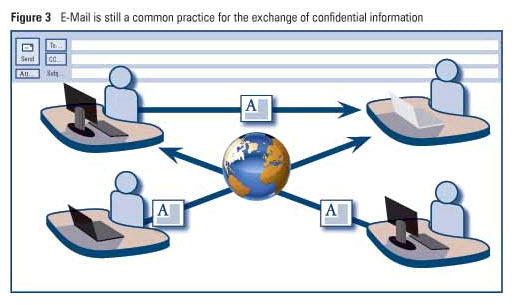
•Unnecessary multiplication of documents and bytes when large and confidential files are exchanged via email (see Figure 3). A secure, web-based virtual project place (like Microsoft® SharePoint®) is needed as a document repository that is accessible for all project members and enables the collaboration on documents and data (see Figure 4 ).
•A lack of e-skills, resulting in:
– missing interdisciplinary communication with ICT specialists regarding ICT-needs (either company-internal or service provider)
– suboptimal use of software (using the computer as a “typewriter” without being aware of useful software functionalities or the information about additional software to optimize specific working practices)
– Lack of knowledge about electronic document properties and how to change them (image-based versus text-based PDFs, protected PDFs, file size reduction, inherit zoom magnification, file size reduction, etc.)


In light of these challenges, the following questions arise:
Do regulatory affairs professionals bring along the required e-skills to adapt innovative e-working practices in order to manage a complex eCTD submission project? If not, what measures will become necessary?
One answer was given in last year’s European e-Skills Conference: “Organizations need to invest not only in infrastructure but in the higher level e-skills of their workforce…. The critical factor for future success…is the capacity for the competitive application of technologies.
In conclusion and in view of Europe’s digital agenda, the time has come for Good e-Submission Practice.
About the Author
Barbara is based in Switzerland. She is the Managing Director of PhACT GmbH; a company that provides advice and service in drug regulatory affairs, with a specialty in EU regulatory submissions including biotechnology. Barbara has more than 20 years of experience in regulatory affairs and previously worked with the Federal Institute for Drugs and Medicinal Devices (BfArM)-the German Health Authorities.
The specification for the eCTD is based on “Extensible Markup Language” (XML) technology and lists the criteria that make an e-submission technically valid. It focuses on “the ability to transfer the registration application electronically from industry to a regulatory authority.” The data and document files that form part of a submission are mostly provided in a portable document format (PDF) and are embedded into the XML backbone of the eCTD.
The change from paper to e-submissions bears some challenges: The implementation of suitable information and communication technology (ICT), the adaption of related business processes, as well as working practices, and particularly, the professional use of ICT play key roles for a successful e-submission project.
As brought to the point in Europe’s Digital Competitiveness Report 2010: “Investment in ICT is not sufficient if not accompanied by the reorganization of internal processes. ICT applications that help automatic business processes can be an important source of efficiency gains when accompanied by innovative working practices and the appropriate skills.
In this context, particularly in view of Europe’s digital agenda for a flourishing digital economy by 2020, it is worth exploring whether current practices can allow the efficient handling of an eCTD submission project.
“eCTD-compliant” Navigable Files
One major advantage of the eCTD is its ability to allow navigation through a complete electronic submission. However, the eCTD can only be navigated provided that each file is navigable itself and provided referenced files are hyperlinked with each other.
In order to become “navigable,” the PDF files need to fulfill specific formal requirements (e.g., document granularity, specific file names) and need specific properties which allow navigation, like bookmarks, intra- and inter-text hyperlinks (see Figure 1). The properties of a PDF file are specified in a U.S. FDA guidance and in a number of regional eCTD-related guidance documents.

If the author or writer of a document does not consider these requirements, a file needs to go through numerous time-consuming formatting steps until it is ready for a submission in eCTD format (for examples, see Figure 2). That happens mainly when the files are provided by external parties, e.g., Clinical Research Organizations (CROs) or medical writers.

The major efforts of time-consuming reformatting can be prevented by standardizing the document format. This can be achieved by either using harmonized templates and/or by setting up a style guide where aspects of document granularity, document formats, hyperlinking, etc., are specified. However, all parties/persons providing submission-relevant files need to be informed and trained, if necessary, in the document format standardization or as the U.S. FDA points out on its related website “Ask CROs in advance to provide reports in searchable PDF format compliant with the ICH M4 Granularity Annex and FDA PDF Specification.”
Even when working with standardized document format, interoperability problems may occur by using different operating systems and software standards (e.g., by using different Microsoft® Office software versions). Before exchanging any submission-relevant files with external parties, an interoperability check may help to identify and prevent the problems.
The need for “interoperability and standards” was identified as one of the seven actions in Europe’s Digital Agenda Communication initiated to make “proposals for actions that need to be taken urgently to get Europe on track for smart, sustainable and inclusive growth….”
Adapting Business Processes, Working Practices & Improving e-Skills
Working with electronic files rather than paper requires the adaption of eCTD-related business processes.
The eCTD submission project can only be efficient when the underlying business processes are accompanied by innovative e-working practices and the appropriate e-skills.
In practice, however, and as listed below, business processes and working practices sometimes run counter to an efficient eCTD submission project processing, especially in small and medium-sized enterprises (SMEs).
The following are common challenges an eCTD submission project can face, but it is certainly not an exhaustive list:
•Inadequate or even missing project management skills. There is a risk that the eCTD submission project could get out of control and be behind schedule.
•Unnecessary multiplication of documents and bytes when large and confidential files are exchanged via email (see Figure 3). A secure, web-based virtual project place (like Microsoft® SharePoint®) is needed as a document repository that is accessible for all project members and enables the collaboration on documents and data (see Figure 4 ).
•A lack of e-skills, resulting in:
– missing interdisciplinary communication with ICT specialists regarding ICT-needs (either company-internal or service provider)
– suboptimal use of software (using the computer as a “typewriter” without being aware of useful software functionalities or the information about additional software to optimize specific working practices)
– Lack of knowledge about electronic document properties and how to change them (image-based versus text-based PDFs, protected PDFs, file size reduction, inherit zoom magnification, file size reduction, etc.)

In light of these challenges, the following questions arise:
Do regulatory affairs professionals bring along the required e-skills to adapt innovative e-working practices in order to manage a complex eCTD submission project? If not, what measures will become necessary?
One answer was given in last year’s European e-Skills Conference: “Organizations need to invest not only in infrastructure but in the higher level e-skills of their workforce…. The critical factor for future success…is the capacity for the competitive application of technologies.
In conclusion and in view of Europe’s digital agenda, the time has come for Good e-Submission Practice.
About the Author
Barbara is based in Switzerland. She is the Managing Director of PhACT GmbH; a company that provides advice and service in drug regulatory affairs, with a specialty in EU regulatory submissions including biotechnology. Barbara has more than 20 years of experience in regulatory affairs and previously worked with the Federal Institute for Drugs and Medicinal Devices (BfArM)-the German Health Authorities.
16 June 2011
eCTD Tips: Microsoft Office 2010 and PDF Creation Problems
In a previous post, I discussed a minor issue that we encountered when my company recently upgraded from Microsoft Office 2003 to Microsoft Office 2010. In this post, I’ll describe a more serious problem caused by the update and the (relatively) easy solution we finally discovered.
The Problem
Prior to the upgrade, we used the “Create a PDF” button on the Acrobat toolbar in Word to create PDFs for submissions. As you know, PDFs created using this button will include functional bookmarks based upon the heading styles used, a fully hyperlinked table of contents, and functional internal hyperlinks within the text of the document (if they were created by the author). Shortly after the upgrade from Microsoft Office 2003 to Microsoft Office 2010, we noticed that the “Create a PDF” button was no longer functional in any Office application – nothing happened at all when we clicked it.
While our IT staff contacted both Microsoft and Adobe regarding this issue, my team began investigating workarounds to minimize the impact this would have on our publishing work. Unfortunately, we were only able to come up with two, less-than-stellar options.
Potential Solution #1 – Print to PDF
We quickly discovered that we could still create PDFs by printing to the Adobe PDF printer, but this option is far from ideal for documents destined for an eCTD submission. PDFs created using the Print function do not include any automatically created bookmarks or hyperlinks. Using this option would require us to manually create bookmarks and hyperlinks in every document. While this could be acceptable in limited circumstances, it’s certainly not a practical solution for producing eCTD submissions on a daily basis.
For More information about this article click here: eCTD Tips: Microsoft Office 2010 and PDF Creation Problems
15 June 2011
The Flow of Data from Bench to Bedside: Finally Enabled by Electronic Submission - By by Dirk Karsten Beth, President of Mission3, Inc
As with other industries, information is the substrate of Life Sciences, yet the Life Sciences have been slower to adopt information technology than other industries. Aircraft manufactures have been "virtually" test flying aircraft for decades now. The financial industry has been working with electronic regulatory submissions for about the same amount of time. But we are at a new age of life sciences, a period where discovery through bedside will be enhanced through the use of information technology.
The greater adoption of IT in Life Sciences is being driven not only through the clear benefits in quality and efficiency that we can all understand, but through market pressures and changes in the life sciences industry. Fewer blockbuster drugs and a higher failure rate in the discovery process; pharmacogenomics requires management of an ever increasing number of products in the portfolio; greater regulatory pressure; global development; biosimilar, biogeneric and generic pharmaceuticals are all affecting the way pharmaceutical and biotechnology companies operate. The response to this market pressure is a more efficient and effective industry — lead by information technology.
The true power of IT systems is first realized as the data flows freely from one system to the other and, as Life Sciences companies automate more processes internally, integration will lead to increased efficiency and quality.
For More Information Please us the weblink: The Flow of Data from Bench to Bedside: Finally Enabled by Electronic Submission.
Free Educational Webinar – New Rules in FDA Safety Reporting: Are You Prepared? - Download the Slides
Free Educational Webinar – New Rules in FDA Safety Reporting: Are You Prepared?
By Dr. Jack Snyder and Angela Overton of Cato Research 15 June 2011
Slides can be downloaded by clicking the weblink: Catco- New Rules in FDA Safety Reporting
By Dr. Jack Snyder and Angela Overton of Cato Research 15 June 2011
Slides can be downloaded by clicking the weblink: Catco- New Rules in FDA Safety Reporting
CDISC Live Free Webinar: CDISC Medical Device Standard - Your Change to Preview this New CDISC Standard
CDISC Live Webinar: CDISC Medical Device Standard - Your Change to Preview this New CDISC Standard
Friday 18 August 2011
11:00 AM Eastern / 10:00 AM Central
For more information and register for webinar please click: CDISC Live Free Webinar
Friday 18 August 2011
11:00 AM Eastern / 10:00 AM Central
For more information and register for webinar please click: CDISC Live Free Webinar
Submission Document Granularity - By Scott Cleve
Submission Document Granularity
by Scott Cleve, Director, Regulatory Affairs & Chris Buckley, Regulatory Affairs Associate Director at Astellas.
At its most basic level, increased document granularity within a submission simply means that there will be more documents to process and populate into a submission structure. More documents than what? - might be the next logical question. In the early years of electronic submissions most clinical study reports, were large and all inclusive of attachments and appendices. The drug product and drug substance documents were rolled up into complete files, respectively. Depending on the size of a study, a clinical study report document could exceed 100 MB in size and make the most confident publisher concerned about file corruption and poor performance. At that time, there were no requirements or expectations to sub-divide these documents into small defined granules by ICH or any regulatory authority.
Fast forward to the implementation of the Common Technical Document (CTD) and corresponding eCTD submission format that requires a greater degree of document granularity within a submission. With this emerging standard, the large documents needed to be authored as granular documents while still maintaining the overall content, research, and analysis of the entire topic (e.g. drug substance, drug product, clinical study). A benefit of the granulated approach is the ease of making changes or updates, review and approval, and lifecycle publishing of the granular document(s). On the publishing side, this concept eliminated the need to recreate bookmarks and hyperlinks in a large document and only perform these activities on the granular document(s). A challenge of maintaining granular documents is the need to conduct an impact analysis by the author and/or responsible department(s) to understand how a change to one granular document might impact other granular documents within the submission. A missing document in this analysis could result in an inconsistent message submitted to a regulatory authority, a problem that no sponsor company invites! Another challenge is maintaining the lifecycle links when certain destination documents are replaced or appended. Most current software cannot automatically update hyperlinks; therefore, potentially confusing the reviewer with outdated or broken links.
If you recall the basic concept of submission granularity of using a larger number of documents to create submissions, we have now complicated matters a bit. What was originally perceived as a submissions operations or publishing task is now an organizational, or at least a departmental process and/or strategy to develop granular content for submissions. It is not as simple as taking a large document and breaking it into smaller components. These components need to relate to each other and continue to provide continuity of the science and research of the submission application throughout its lifecycle. That is the entire organization’s responsibility, and not just the concern of the medical writing or publishing function. This change to a granular authoring approach may begin with the submissions operations or publishing group, but to successfully granulate documents the entire organization needs to be invested in developing granular content.
Source: GlobalSubmit Newsletter
http://globalsubmit.com
14 June 2011
RAPS’ So. Cal. Workshops to Cover Increasingly Accepted Electronic Regulatory Submissions
RAPS’ So. Cal. Workshops to Cover Increasingly Accepted Electronic Regulatory Submissions
Regulatory agencies, including FDA and other global health regulators are increasingly accepting, and in some cases requiring, regulatory submissions in the electronic Common Technical Document (eCTD) format. The Regulatory Affairs Professionals Society (RAPS) will host two workshops on eCTD submissions in July in Long Beach, CA.
For More Information please click: RAPS Workshop eCTD
RPS: The Next Phase of eCTD (Regulated Product Submission Standard Increases Flexibility, Capabilities) By Joel Finkle
RPS: The Next Phase of eCTD
Regulated Product Submission standard increases flexibility, capabilities.
By Joel Finkle
June 8, 2011 | Guest Commentary | Today, almost two-thirds of all drug license application and renewal submissions are provided in the approved electronic Common Technical Document (eCTD) format. That figure rises to over 90 percent for electronic submissions to the U.S. Food and Drug Administration (FDA). This makes the job of the FDA much easier, allowing staff to call up and navigate their way through submissions quickly and logically. Applications are put together using meta tags and hyperlinks to attach related content in a way that makes the applications easily searchable.
Inevitably, eCTD has changed the way individuals and teams work, reducing bottlenecks and increasing accuracy by facilitating collaboration and parallel working, guided by clever software and even more clever business practices. In time, investments in compliant systems and processes will turn out to have been well worth it—especially when once-lengthy timescales for submission processing, reviewing, and approval are reduced.
In the same spirit, then, organizations should not be too alarmed to learn that there’s another new submission standard on the horizon.
For More Information Please use the link: BioIT World eCTD
10 June 2011
EXTEDO Webinar - Managing the eRegulatory Submission
EXTEDO Webinar - Managing the eRegulatory Submission Lifecycle
Thursday, June 30, 2011 2:00 PM - 3:00 PM EDT
Please here to Register the Webinar: EXTEDO Webinar
Thursday, June 30, 2011 2:00 PM - 3:00 PM EDT
Please here to Register the Webinar: EXTEDO Webinar
EMA/TIGES issues Clarification Concerning the New Validation Criteria (3.1) for eCTD - Clarifies Pass Criteria

The Telematic Implementation Group for electronic submission and ICH Implementation(TIGes) has published additional clarification on the draft eCTD validation criteria 3.1 as published earlier this year (see our related News article).The additional clarification concerns the validation checks that require the presence of the previous eCTD lifecycle sequences to be performed correctly.
The first key message included in the clarification document is that "the revised criteria for technical validation of eCTD sequences (v3.1) should be treated as a single complete set of tests and not be divided in any way."
For More Information please click: EMA New Validation Criteria (3.1)
Swissmedic withdraws eCTD specification 1.01 and eCTD validation criteria 1.0
Swissmedic withdraws eCTD specification 1.01 and eCTD validation criteria 1.0
Please Click: Swissmedic eSubmissions Withdraws
Please Click: Swissmedic eSubmissions Withdraws
eCTD Office fully supports the creation of national e-submissions for Halmed/Croatia
eCTD Office - VNeeS Compiler - Full Support For VNeeS 2.0
(Veterinary) VNeeS Compiler, a part of eCTDOffice, is an off-the-shelf Windows software application for building error-free eSubmission for Veterinary Applications.
In March 2011, the TIGes Veterinary Subgroup has posted a new Guideline on eSubmissions for Veterinary Products. Guideline v.20 will come into effect on 01.09.2011.
Make sure September 2011 does not surprise you!
VNeeS Compiler fully supports the creation of VNeeS e-Submissions for pharmaceutical, immunological and MRL products. Both version 1.1 and recently published version 2.0 are supported.
VNeeS Compiler features:
Creates valid 1.1 and 2.0 Veterinary NeeS e-Submissions.
Creates VNeeS for a pharmaceutical, immunological or a MRL product.
Convert MS Word to PDF at export.
Splits / merges PDF documents.
Creates / auto-corrects PDF hyperlinks.
Generates GTOC and TOC files.
more reasons to choose VNeeS Compiler...
For More Information Please Click: eCTD Office
TOPRA Regulatory Rapporteur: The implementation of eCTD in Japan
were as reference documents. However, the situation changed significantly in April 2009,when Japan’s Ministry of Health, Labour and Welfare (MHLW) issued a notification6 that paper dossiers were no longer required if applicants submitted the eCTD as the original dossier. Previously, the entire paper dossier was requested even if the eCTD was submitted as an original. Although paper Modules 1 and 2 are still required for review when the eCTD is submitted as the original dossier, it is no longer necessary to submit paper Modules 3, 4 and 5. As Figure 1 indicates, as the benefits of the eCTD have become better understood, the number of applications in eCTD format as the original dossier has increased.
For More Information please use the below link: TOPRA Regulatory Rapporteur: The implementation of eCTD in Japan
For More Information please use the below link: TOPRA Regulatory Rapporteur: The implementation of eCTD in Japan
07 June 2011
TheeCTDSummit: The Latest on Regulated Product Submission (RPS)
It has been a while since I have updated you on the RPS project. Back in September, I had expressed cautious optimism on being able to bring RPS to vote (ballot) in May 2011. We did not make the May 2011 ballot, thus the ballot is now delayed until September 2011.
We did not make the ballot, in my opinion, since we are still working on refining all of the requirements. We have two requirements left to be finalized; namely, being able to reuse studies and all of the components in two applications and support for the new European variation legislation.
Being able to reuse studies and all of the components in two applications will allow sponsors to create a study, define all of the components (e.g. protocol, study report body, synopsis, etc) in one application (e.g. investigational application) and refer to the study in your marketing application. This benefits sponsors since it allows them to synchronize content for a study in more than one application.
For More Information Please Click the Link:TheeCTDSummit: The Latest on Regulated Product Submission (RPS)
04 June 2011
Microsoft Case Studies: Healthcare Company Expects Online Collaboration to Save Millions of Euros By Using eTMF
Healthcare Company Expects Online Collaboration to Save Millions of Euros
Sanofi is a multinational pharmaceutical company engaged in the research and development, manufacturing, and marketing of prescription drugs, vaccines, and over-the-counter healthcare products. Sanofi relied on time-consuming, paper-based processes to manage global drug trials. To introduce efficiencies and reduce costs, sanofi deployed a digitalized version of its previous method. Called the Clinical Trial Portal, the solution is based on the Clinical Portal solution from NextDocs that uses Microsoft portal, collaboration, and content management technologies. The new solution will accelerate time-to-market for new drug therapies and is expected to save an estimated 10,000 working days—costing €6.4 million (U.S.$9 million) in time wasted managing documents—when it is deployed to more than 3,000 internal and 40,000 external stakeholders over the next few years.
Situation
Sanofi has an extensive portfolio of prescription drugs, vaccines, generics, and consumer healthcare products targeting traditional markets and emerging countries. Sanofi addresses fundamental health issues and makes major therapeutic solutions available in its areas of expertise: oncology, diabetes, thrombotic and cardiovascular diseases, and central nervous system disorders. Sanofi Pasteur, the vaccines division of sanofi, offers vaccines protecting against 20 infectious diseases. Sales in 2010 for sanofi were €30,384 million (U.S. $43,967 million).
Goal to Streamline Drug Trials
To enable its strategic goals and build a more agile, adaptable organization, sanofi is improving efficiencies in its key business processes. The company began by focusing on how it brings its drugs to market. For sanofi, bringing a drug to market is a multiyear, complex process of global proportions. Expediting this process depends on the successful completion of clinical drug trials. At any given time, the company has dozens of trials in progress. For any trial, sanofi international clinical trial managers (CTMs) could be collaborating with affiliate hospitals or health facilities in as many as 50 countries, where clinical research associates (CRAs) at hundreds of local sites manage trial data from primary investigators, or physicians, administering the drug to many thousands of patients.
A Paper-Based Process
At sanofi, managing clinical drug trials was primarily a paper-based process. “Each clinical trial can generate more than 25,000 documents,” says Denis Cardinal, Domain Manager, Clinical Information and Collaboration, at sanofi. “These are collected during the course of the trial in a trial master file [TMF].”
At the beginning of a trial, when sanofi determines the feasibility of working with a local hospital and verifies that investigators have all the equipment and expertise to proceed, many documents travel between research sites and sanofi locations. However, there’s also a steady stream of documents sent back and forth in the intervening months or years of a trial. From start to finish, each document, and every subsequent revision to that document has to be collected locally, printed, signed, and sent to sanofi. There, sanofi quality control employees compile the TMF and store the documents in boxes to ensure that the company has an audit trail that shows how it complied with standard procedures every step of the way.
The logistics of managing this paper-based process for dozens of concurrent trials was daunting. Faxing, sending by courier, and emailing documents to sanofi was expensive and time consuming. Before participating in a clinical trial, physician investigators must sign a 1572 form required by the Food & Drug Administration (FDA). In addition, signed contracts and confidentiality agreements are required from CRAs at affiliate hospitals. Obtaining the original signatures on paper documents could take weeks. During the course of the trial, CTMs had to locate the right documents and ensure that they were up-to-date, which also incurred delays in the process.
Manual data gathering and file processing opened up the increased possibility of error; missing documents had to be found and entered into the TMF before the study could be officially closed. Also, with a paper-based document management system, it was very difficult to use and store metadata, such as authors, dates and other important contextual information. In the context of a long-term clinical trial, metadata is very important because it provides irrefutable evidence of who authorized, revised, and signed documents, and when. This information helps sanofi to follow industry regulations for clinical document management.
CTMs wanted an easy way to gain visibility into a trial’s progress instead of searching through the TMF or tracking down documents that might still be in transit. With trial documentation located in various places, it was difficult to ensure that clinical milestones were reached according to schedule and to communicate accurate progress reports to the team. Similarly, sanofi executives did not have an up-to-the minute, global view of all trials underway.
“We needed to replace an outdated paper-based process and align ourselves with the health industry’s push towards electronic data exchange that adheres to the latest regulations on security and privacy,”
says Cardinal. “We envisioned a web-based portal solution that would encompass sophisticated document management capabilities, including digital signatures, and a global framework to enable internal and external stakeholders to collaborate and communicate efficiently on clinical trials. The solution had to provide easy access to clinical trial documents and applications and a global view of each study’s progress.”
Solution
After evaluating different document management and collaboration solutions on the market, sanofi narrowed its decision down to two vendors: Microsoft and a leading competitor. As part of its evaluation, sanofi invited Microsoft Managed Partner NextDocs to visit the Paris headquarters and conduct a proof-of-concept (POC). NextDocs has expertise in building SharePoint-based compliance solutions that address regulatory requirements in the healthcare industry. Sanofi was interested to see how the NextDocs Clinical Portal solution worked with Microsoft Office SharePoint Server 2007 to fulfill the company’s requirements for an easy-to-use health portal and compliant document management solution.
The Clinical Trial Portal built on Microsoft technologies enables efficient global collaboration that directly supports our ambition to … sit among the top clinical development performers.
Fabien Jolly
Vice President,
Technology and Information Management,
sanofi.
“When we saw SharePoint Server in action with the NextDocs Clinical Portal solution, which ensures industry regulatory compliance, we were won over by the ease of use, adaptability, and additional functionality of the technologies,”
says Cardinal. “SharePoint Server offers much more than document management capabilities: it’s a scalable, user-friendly portal and collaboration platform with additional features such as subscriptions, notifications, shared calendars, and message boards. We had already deployed Office SharePoint Server 2007 for a few internal collaboration sites and we appreciated the value of taking advantage of existing IT capabilities.”
Sanofi also chose Office SharePoint Server 2007 because it could easily interoperate with existing line-of-business solutions, including the Clinical Trial Management System (CTMS) and an Oracle-based solution that tracks employee permissions to access corporate network resources. Also, the company liked the product’s familiar, easy-to-use interface. The interoperability between Office SharePoint Server 2007 and Microsoft Office desktop productivity software would ensure a ready adoption of the solution for clinical research associates and investigators because they could access and store documents within the familiar Office business applications that they rely on to create and modify content.
Requirements Gathered
Beginning in June 2009, sanofi began gathering high-level requirements from CTMs, hospital staff, doctors, and CRAs around the world. This tremendous undertaking was necessary to ensure the creation of a digital system that improved upon the manual process. At the height of the project, there were 40 people from sanofi involved in different project areas such as trial contact management, integration with external systems, and building standardized taxonomy and metadata.
“With our new clinical trial portal, we were determined to design and implement optimized processes and to standardize document metadata,” says Cardinal. “We defined 650 different document types. All documents are tagged with clinical keywords defined by the team so we can use SharePoint search functionality instead of looking through paper files. All the document templates were set up using the same phrases and keywords throughout the company so that documentation will be standard and familiar to everyone.”
Instead of sending paper documents to be filed in the TMF in boxes at sanofi locations, internal and external stakeholders will upload documents to the Clinical Trial Portal to create an electronic Trial Master File, (eTMF) that stores documents and all associated updates online. The difference is that now, based on user access and permissions, internal and external international team members will be able to see the contents of the eTMF and watch carefully as documents are added and milestones are reached.
Security Concerns Addressed
As sanofi makes the transition to a digital clinical trial management process and electronic text documents replace paper records, it must comply with government and industry regulations that govern the flow of digital information. Working with NextDocs, sanofi added electronic and digital signature capabilities and new workflows that comply with Title 21 CFR Part 11 containing FDA guidelines on electronic records. Now an investigator can file a 1572 form online using a digital signature, which is a coded message unique to both the document and the signer. Sanofi has 30 days to process these forms, so in order to stay on schedule a SharePoint-based workflow sends a reminder email message to the correct recipient’s Microsoft Office Outlook inbox or mobile phone using Microsoft Exchange ActiveSync technology.
NextDocs used SharePoint Timer jobs to ensure that the Clinical Trial Portal module interoperates with the CTMS to synchronize portal data with the information contained in the CTMS and an Oracle-based permissions system. This makes it easy for sanofi staff to share appropriate study and management data from the CTMS system with trial participants around the world. For example, trials with an affiliate hospital must include a signed confidentiality agreement that resides in the CTMS. For the link to the permissions system, NextDocs developers simply replicated existing permissions when assigning users to the Clinical Trial Portal, which ensures that everyone continues to access the information for which they have permission, according to responsibility and position.
Designed to Scale
Sanofi is in the final stages of deploying the Clinical Trial Portal based on Office SharePoint Server 2007, running the solution in the test and development environment to correct any last-minute issues. The company released the first live version of the Clinical Trial Portal in April 2011 and by May 2011 two new studies were using the system. Another two new studies are also scheduled to start using the system in May 2011. NextDocs offers a version of its clinical health portal that takes advantage of Microsoft SharePoint Server 2010 and sanofi will be upgrading its Clinical Trial Portal to SharePoint Server 2010 at the beginning of 2012.
While the first live studies will focus on two small trials, sanofi designed the Clinical Trial Portal to scale to thousands of users and has high expectations for performance and reliability. “When we are fully deployed, we’re expecting to reach approximately 3,000 internal users, including affiliate staff at up to 10,000 hospital sites, where between 30,000 and 40,000 doctors will be gathering and uploading clinical trial data into the portal,” says Cardinal. “We worked with Microsoft to complete two performance tests to ensure our SharePoint environment is well-configured and scalable. We’re confident that the clinical portal solution will perform well. Using the system requires little training, encouraging a quick adoption rate and positive user response.”
“With the new Clinical Trial Portal, we leverage best-in-class portal and document management technologies to produce a rich user experience and enable efficient global collaboration,” adds Fabien Jolly, Vice President of Technology and Information Management at sanofi.
Benefits
Thanks to Microsoft collaboration technologies, sanofi is poised to experience a paradigm shift in clinical trial management and operational efficiency. Replacing a manual, paper-intensive process with a web-based digital solution was a daunting project. However, the company benefitted from the Microsoft partner ecosystem by taking advantage of NextDocs’ expertise in extending SharePoint technologies to meet its needs. The end result combined health portal capabilities with compliant document management to deliver an innovative solution that will speed time-to-market, improve productivity, reduce costs and risk, and drive a competitive advantage.
“In a networked, open source environment, the Clinical Trial Portal leverages the capabilities for integrated technologies, improves the productivity, speed, and quality of our trials, and liberates the investigators to focus on the care of the patients,” says Ji Zhang, Vice President, Head of Clinical Sciences and Operations Worldwide, sanofi.
Increased Insight Improves Trial Management
Instead of waiting until the end of a trial to ensure that all required, signed documentation is included in the trial master file, CTMs will be able to monitor which documents are added and when, taking steps along the way to submit the proper documentation to applicable regulatory agencies on time and to ensure that nothing is missing before going to the next step.
With the new Clinical Trial Portal, we leverage best-in-class portal and document management technologies to produce a rich user experience and enable efficient global collaboration.
Fabien Jolly
Vice President,
Technology and Information Management,
sanofi
“With real-time document submission to the Clinical Trial Portal, trial managers can measure the performance of their teams to see if they are providing the right information,” says Cardinal. “And with aggregate trial data available, sanofi executives will gain a new level of insight into global operations.”
Seamless Collaboration Drives Productivity
The Clinical Trial Portal provides easy access to one platform so that all internal and external stakeholders will be able to collaborate and communicate efficiently on drug trials no matter where they are in the world. The solution not only delivers streamlined information sharing for clinical trial data, but also facilitates access to data from back-end clinical management and user permission applications.
If one team member adds a document, or updates a file, everyone else on the team will be instantly aware of the change and can work with the most recent draft. With everything located in one easily accessed location, sanofi estimates that document versions will be reduced by 30 percent.
“Instead of phoning and emailing clinical trial team members, our stakeholders will be able to work together more efficiently, responding to issues and delivering results more quickly,” says Cardinal. “When an investigator connects to the portal, he or she will see all the documents in the electronic Trial Master File and all contact information for his or her colleagues throughout the trial. Easy communication and collaboration builds teamwork and improves productivity all around.”
Digital Collaboration Reduces Costs
After sanofi rolls out the Clinical Trial Portal globally, the company will be saving a significant amount of money on long-distance phone bills and fax, courier, and paper costs. “It’s easy to imagine the savings in labor costs if you think about the time and effort required to manage 25,000 documents, and that’s just for one trial,” says Cardinal. “Even if we take into account the cost of maintaining the new system, we still expect to experience a positive return on investment within the first 2 years.”
As an example, for a single study the average trial master file contains up to 25,000 documents. Conducting 100 trials per year requires the creation, review/approval, and management of up to 2,500,000 documents per year. “If we consider that for each document lifecycle we could save only 2 minutes—a very conservative example—in searching, processing, and posting documents, it adds up to 5,000,000 minutes, or approximately 10,000 person-days of time savings per year,” says Cardinal. “At a conservative average hourly wage of €80 for the sanofi employees involved in managing documents for the clinical trials, this could add up to a savings of €6.4 million in labor costs when the solution is fully deployed over the next few years. Now the trial stakeholders can focus on additional added-value or core medical activities.”
Faster Time-to-Market Improves Public Health
The Clinical Portal Solution provides a communication forum for users to share their views about a clinical trial in real time. It used to take several weeks to obtain signed contracts before launching a trial, but now this step will be accomplished in minutes, thanks to the digital signature function in the Clinical Trial Portal. And CTMs and quality assurance staff will no longer be spending days sorting through the TMF to make sure it contains all of the documents required by regulatory agencies: this task will be accomplished at regular intervals as documents are uploaded during the course of a trial, saving a significant amount of time.
“The Clinical Trial Portal will simplify the day-to-day activities of thousands of people that work in our clinical trials,” says Marie Sebille, Vice President of Trial Operations at sanofi. “This will help us gain time during the startup and completion of a trial, which is one of our major challenges.”
“We expect the Clinical Trial Portal to help us bring drugs to market faster,” adds Cardinal. “That’s because everyone will be working in a secure, compliant environment where it’s easy to create, store, and find the documents they need, when they need them.“
Regulatory Compliance Features Reduced Risk
The Clinical Portal Solution will make it easier for sanofi to satisfy regulatory compliance requirements by providing audit trails, electronic signatures, strict access control, accurate copies, and proper storage of all document versions.
“In the pharmaceutical industry, we can’t negotiate with quality control,” says Cardinal. “Now that we have metadata specifying the author and revision history for each document, we will be able to track and audit every transaction.”
Innovation Builds Competitive Advantage
With its Clinical Trial Portal based on Microsoft technologies, sanofi has moved to the forefront of drug trial management innovation. When it rolls out the solution worldwide, sanofi expects positive feedback from clinical research associates and investigators working in the field. “We appreciate that for our investigators this is additional work to caring for their patients, so we want to make it as easy as possible to work for sanofi,” says Cardinal. “The Clinical Trial Portal will be an important tool that we can use to differentiate our company and keep our investigators happy, because they are essential to the process.”
Eventually, sanofi could use the Clinical Trial Portal to forge partnerships with other organizations, a key element of the company’s evolving business model. “This portal is truly welcomed by the clinical study units,” adds Mark Travers, Vice President, Clinical Study Units at sanofi. “We see it as a strategic vehicle where sanofi and our partners can exchange information in real time and as the interface of our organization with the clinical research community.”
“The Clinical Trial Portal built on Microsoft technologies enables efficient global collaboration that directly supports our ambition to be a sponsor of choice for clinical trials and to sit among the top clinical development performers,” concludes Jolly.
Microsoft Solutions for the Healthcare Industry
Healthcare and life sciences organizations are under tremendous pressure to meet regulatory requirements, improve patient care, and reduce the time it takes to develop drugs and take them to market. To meet this challenge, Microsoft and its partners have developed cost-effective solutions that enable healthcare organizations to streamline and automate daily processes that improve productivity and deliver information whenever and wherever it is needed. The result is enhanced productivity, safety, and quality.
For more information about Microsoft solutions for the healthcare industry, go to:
www.microsoft.com/healthcare
IIR :eCTD Seminar in Spain:"ECTD Electronic Drug Registration up to date" - Barcelona, October 4, 2011
IIR :eCTD Seminar in Spain:"ECTD Electronic Drug Registration up to date" - Barcelona, October 4, 2011
For More Information Please click the link: eCTD Seminar in Spain
For More Information Please click the link: eCTD Seminar in Spain
02 June 2011
Article: The Challenges of e-Publishing in Regulatory Affairs in online journal International Pharmaceutical Industry
Article: The Challenges of e-Publishing in Regulatory Affairs in online journal International Pharmaceutical Industry
Please click the link to find the Article: The Challenges of e-Publishing in Regulatory Affairs
Please click the link to find the Article: The Challenges of e-Publishing in Regulatory Affairs
ECTD: A Business Case for Small to Midsize Companies - presentation from Monte Levinson
ECTD: A Business Case for Small to Midsize Companies - presentation from Monte Levinson
Please click the link to find the presentation: ECTD: A Business Case for Small to Midsize Companies
Please click the link to find the presentation: ECTD: A Business Case for Small to Midsize Companies
Health Canada: Drug Submission Performance Reports

he Drug Submission Review Performance Reports provide detailed metrics about the timeliness of pre-market drug review process against the performance service standards. The annual report compares five calendar years, while the quarterly report compares five quarters. The reports are broken down by operational areas. The Therapeutic Product (TPD) Report covers pharmaceuticals, while the Biologic and Therapeutic Products Directorate (BGTD) Report covers biologics. Within each report, statistics are provided by submission type and show the number received, the number in workload, the number of decisions and the number of approvals and time to approval.
Submissions Received are counts of submissions received during the year using from the filing date. Workload is reported as the number of submissions "under active review" on a given day. "Backlog" is the proportion of the workload that is over target. Approvals are Notice of Compliances (NOC) issued or issuable. A NOC issuable is when a submission's NOC is placed "on hold" awaiting authorization to market, due to Patent regulations or due to de-scheduling (from prescription to Over the Counter).
For More Information please Click: Drug Submission Performance Reports
01 June 2011
HMA & EMA: More Transparancy in Application Dossiers - DRAFT FOR PUBLIC CONSULTATION

Document on the Identification of Commercially Confidential Information and Protection of personal Data within the structure of the marketing Authorisation (MA) dossier release of Information after granting of a marketing Authorisation
The Heads of Medicines Agencies (HMA) and European Medicines Agency (EMA) havebeen working together with a view towards achieving greater transparency of their operations and better addressing the increasing requests for information theyfrom members of the civil society.
This draft guidance document is presented as a consensus document agreed by theentire Network of Competent Authorities, laying down practical orientations for national and European authorities in regards to requests for access to information contained in MA dossiers.
For More Information Please Click: HMA & EMA: More Transparancy in Application Dossiers - DRAFT FOR PUBLIC CONSULTATION
European Medicines Agency and Heads of Medicines Agencies propose measures to make information in application dossiers more transparent

The European Medicines Agency and the Heads of Medicines Agencies (HMA) have released a guidance document on the identification of commercially confidential information and protection of personal data within the structure of the marketing-authorisation dossier for public consultation.
The draft document, which is open for comment until 1 September 2011, outlines the types of information included in marketing-authorisation applications that can be released following a request for access to documents, once a marketing authorisation has been granted.
The consultation is being conducted to gather the views of stakeholders, including pharmaceutical companies, healthcare professionals and patient organisations. The Agency and the HMA are particularly interested in receiving comments on the criteria for the release or protection of personal data, whether contractual arrangements between companies need to be maintained as confidential, and how to address the personal security of individuals involved in studies using animals. They are also inviting stakeholders to make proposals on how to make these types of request easier.
For more Information please click: EMA Guidance Document for protection of personal data
DIA Webinar: Electronic Submission Basics Webinar Series: Part 2- eCTD 101: Concepts of the eCTD Standard Sep 22 2011

WEBINAR: Electronic Submission Basics: 3-part Webinar Series: Part 2- eCTD 101: Concepts of the eCTD Standard
Date(s) And Time(s):
Sep 22 2011 11:00AM - Sep 22 2011 12:30PM
Interest Area(s):
Regulatory Affairs,Project Management,Medical Writing,IT/Validation,Clinical Research,Clinical Data Management/ eClinical
Overview:
Register ONLINE in ONE transaction for
MULTIPLE Webinars in this SERIES and SAVE UP TO 15%!*
*Special Pricing Valid only on Online Registrations for Both Individuals and Group Sites!
You may also register for a single webinar (at no discount) online or by fax. See Page 4 of the Series Program for the registration form.
For More Information Please Click: DIA eSubmission Basics Webinar Series
EMA Draft Concept To Revise CTD Guideline For Traditional Herbal Medicinal Products

Concept paper on the revision of the guideline on the use of the CTD format in the preparation of a registration application for traditional herbal medicinal products - Focus on M3 quality
For More information Please Click: EMA - Revise CTD Guideline For Traditional Herbal Medicinal Products
Exalon:New status reports for the European eSubmission Gateway and electronic Application Form project released

The European Medicines Agency has released new status reports regarding the European eSubmission Gateway and the electronic Application Form (eAF) projects. Both status reports have the report date "June 2011" and are available for download from the "eSubmission" website of the Agency.
Short summary eSubmission Gateway Project:
The eSubmission Gateway will use Axway technology to allow registered business partners to send eCTD submissions electronically to the EMA via the gateway. Progress of the project has been delayed for several months due to the resignation of the project manager and subsequently the entire development and test team (see previous status report from March 2011).
According to the new status report the business requirements and software architecture documentation for release 1 of the gateway are final and development test phase have been completed. System testing is currently ongoing and will be completed in June followed by the user acceptance testing.
Modified work instructions for the handling of incoming eCTD submissions and details about the registration process will be published in July 2011.
The pilot phase is planned to start also in July 2011 whereas the start of the production phase of Release 1 of the eSubmission Gateway is planned for October 2011. The Agency expects that "that both methods to submit eCTDs (via CDs/DVDs and via eSubmission Gateway) will be supported for some time"
For More Information Please Click: Exalon: New Status Reports for ESG
Ask Cato: Health Canada Expands Acceptance of eCTD Submissions

Last week, Health Canada (HC) issued a Notice to to announce an increase in the types of submissions being accepted by the regulatory authority in the eCTD electronic-only filing format. Effective immediately, HC now also accepts two new submission types in the eCTD electronic-only filing format:
Notifiable Changes (NC)
Responses to Clarifaxes (If related to a submission filed in eCTD format).
Previously, HC accepted the eCTD electronic-only filing format for the following submission types only:
For More Information Please Click: Ask Cato - Health Canada Expands Acceptance of eCTD Submissions
GlobalSubmit Lunchtime Web Series

Join us for an upcoming web demonstration to discover the advantages of using GlobalSubmit 2010.
See how the FDA views electronic submissions
Build your application as the FDA sees it
Cut days off the time it takes to quality check bookmarks and hyperlinks
Improve your communications both internally and with the Agency
Improve your team’s efficiency and meet important deadlines
Reduce your risk of technical rejections
For Registration Please Click: GlobalSubmit Lunchtime Web Series
Subscribe to:
Posts (Atom)